Cannery Row (Turtleback School & Library Binding Edition) Review
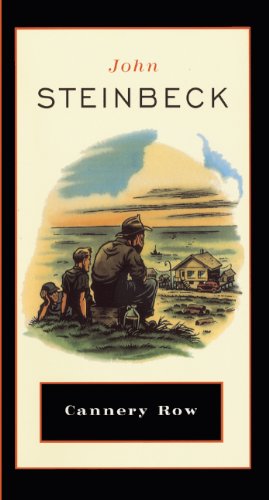
Cannery Row is not Moby Dick or The Great Gatsby. That is, it's not a contender for `the great American novel'. But it is _a_ great American novel. Perhaps the great American anti-novel, for its loosey goosey structure, its whimsical shifting of tone and style, are likely to drive batty anyone who has a very rigid vision of what a novel must be.
This novel follows a long summer-fall season amongst those who lived in Cannery Row, Monterey, during the 1930s but who were not part of the business of canning sardines. That industry permeates their lives -- an endless supply of fish heads for cats, customers for the local businesses, etc. -- but the characters are not part of that industry or any other industry for that matter. They are all marginal to the rest of the world, from the Chinese store owner whose conversations with other people seem limited to discussions of the availability of credit to a male gopher who is conflicted because his paradise home is out of the flow of female gophers, which means he never gets laid. (I'm not making this up.)
The two most main characters, if they can be called that, are Mack and Doc. Mack is `one of the boys' at the Palace Flophouse. You'd call him chronically unemployed -- if the idea of being employed ever occurred to him. The boys individually and collectively don't seem to be playing with a full deck of cards but they live life so grandly and so philosophically that they are wiser than almost any other character or characters in fiction. (Many times, we're told a character is wise but the author can't back it up because they themselves haven't acquired that much wisdom.) Doc, whom I very affectionately envision as a younger version of the Doc in the HBO series Deadwood, is generous and compassionate -- yet lonely -- and the moral center of Cannery Row. [Deadwood with hindsight now looks like an ultraviolent and uncouth version of Cannery Row.] He runs a lab in which he catches animals, mainly from the tidal pools, to sell to schools and universities.
The other reviews note that this novel covers a range of emotions, from tragic deaths (off-stage) to the comic. The humor, however, is more salient: P. G. Wodehouse would have given his right arm to have written this. Many events that most people would cast in a tragic light are played lightly: even when depressed the characters are somehow irrepressible.
Much of the book, in fact, borders on slapstick. A major storyline involves the boys of the Palace Flophouse going on a field trip to catch frogs (to sell to Doc to fund a party for him, which seems perfectly reasonable on Cannery Row). I only have time to read these days when my newborn son is sleeping across my chest and I have to say he didn't particularly care for the frog trip because my continual laughing made his bed a little unstable. To give a flavor: the boys decide that in a trip to the country, the country would provide food, so they only bring salt and pepper. The description of gathering the other ingredients in their stew begins with reference to a rooster that wandered away from a farmhouse they're driving by (in a Model T whose acquisition and maintenance are stories in themselves). The meal begins to take shape: "Eddie hit him [the rooster] without running too far off the road." When Hazel, whose mother was undaunted in her choice of names despite the gender of her progeny, cooks him but warns the others, "He ain't going to be what you call tender."
I would in fact mull over whether this novel sentimentalizes poverty except for two things. First, the book is so extensively based on real life that it barely deserves the label fiction. (There's another book out there called Real Life on Cannery Row. I'm reading it now: one of the most interesting points is that the various buildings really were adjacent to each other and only occupied a small portion of Cannery Row.) Second, the day before I started reading this I spoke with a friend from years past who is larger than life in a Mack kind of way: if he had a ,000 a year job, he'd be so afraid of being corrupted by it that he'd give half away to friends and then convert paychecks into beer until he hit the poverty line. Then he could relax again. So there are people like Mack out there.
On the whole, the novel is able to maintain a balance between the sadness and the joy. Indeed, it does so in such a way that it is one of the few novels in which you could learn something about life.
A lot of authors from the 1920s to the 1940s come across through their characters as perpetually inebriated. Reading Fitzgerald is has a kind of boozy but truthful sadness; Hemingway is like a permanent hangover. Cannery Row and its sequel Sweet Thursday are like perfectly hitting the right point of tipsiness: there's a gloriousness to it, the feeling of being part of a happy conspiracy of everyone drinking at that moment but knowing that come morning all you'll feel are pleasant memories.
Cannery Row (Turtleback School & Library Binding Edition) Overview
FOR USE IN SCHOOLS AND LIBRARIES ONLY. Vividly depicts the colorful, sometimes disreputable, inhabitants of a run-down area in Monterey, California.
Available at Amazon Check Price Now!
Related Products
- Tortilla Flat (Penguin Twentieth-Century Classics)
- Sweet Thursday (Penguin Classics)
- The Winter of Our Discontent (Penguin Classics)
- The Little English Handbook: Choices and Conventions, Longman Classics Edition, MLA Update Edition (8th Edition) (Longman Classics in Composition)
- Tasting the Sky: A Palestinian Childhood
Customer Reviews
Nostalgia - James Barton Phelps - Menlo Park, CA United States
"Nostalgia - (from Greek nostos - return home) - the state of being homesick: HOMESICKNESS; 2. A wistful or excessively sentimental sometimes abnormal yearning for return to or of some past period or irrecoverable condition" - Webster's Ninth New Collegiate Dictionary
In 1945 John Steinbeck, already a successful author, was recovering in New York from physical and psychological wounds received as an active war correspondent in World War II. He returned to his writing and to his memories of where he grew up in as a young man in the late 1920s and early to mid 1930s - to the Cannery Row of Monterey California where the canneries which lined the street extended out over the water to receive sardines by the tons from the sardine boats which brought them in until over fishing ended the catch in the 1950s, where his best friend Ed Ricketts ("Doc" in the book) had run the Western Biological Laboratory until it burned down in 1936, where good hearted people - Lee Chong, the Chinese grocer, Mack and the boys, Dora - the generous madam who ran the whorehouse called The Bear Flag Restaurant - helped the poor, where Gay, Henri the artist and Frankie, the poor lad who couldn't do anything right except love his fellow men hung out on means which were virtually non-existent. The result was this emotional lovely reminiscence of times past told as a novel without a plot but in form a series of stories about his friends who had lived on Cannery Row and what they did when he knew them.
It is writing at its best. The Model T, the frog hunt, the "party" given by "Mack and the boys" for Doc and then the real party given for Doc are episodes we will never forget. And, finally, when those of us who lived through these times, who remember simpler lives, and simpler times, who have walked down Cannery Row before it became a tourist spot and who have seen the shrimpers and the lifting fog and who remember in wistful nostalgia our friends now gone come to the end of the book and read Steinbeck's last stanza of the poem which ends his own thoughts, - the poem which echoes his own nostalgia - we have a tear in our own eye - rightfully acquired,
"Even now,
I have savored the hot taste of life,
Lifting green cups and gold at the great feast.
Just for a small and a forgotten time
I have had full in my eyes from off my girl
The whitest pouring of eternal light"
Touching and Insightful - Bojan Tunguz - Greencastle, IN USA
This short novella is a collection of episodes documenting the lives of several residents of Monterey during the Great Depression. Cannery Row, the book's title, is merely a fictional street in Monterey, but after the book's success became the name of an actual street in that city. Each chapter in the book is a more or less self-contained story, but all of them function cohesively in creating the overall effect of a unified narrative. There are certain characters that feature more prominently throughout the book, and they serve as fulcrums around which the book revolves. Steinbeck is a masterful storyteller, and his insights into human nature and our motives are as fresh today as they were when this book was originally published. His crisp, linear narrative style is a refreshing antidote to much of the experimental and conceptual fiction that was in vogue in the middle of the twentieth century. Whether you have read his other works or are new to this great American author, you will find a lot to enjoy and appreciate in this short book.
Wonderful Steinbeck! - J. P. Shepherd - Layton, UT
Classic Steinbeck! Great character sketches that are fun to read; I found myself laughing out loud in quite a few places. The characters are easy to relate to, with Doc and Mack being my favorites. When I read Steinbeck I see a little bit of myself in each of the characters - the good and the bad. It is therapeutic!
Cannery Row also provides a great look at early Monterey. Having been to the area several times, it makes it all the more enjoyable to revisit the streets, hills and coast through Steinbeck's descriptions and think about how the area might have looked, felt and smelled before I ever had the chance to see it.
Cannery Row is a fun, light read compared to many of Steinbeck's other works, but it is still a great book and a wonderful representation of the author's style. I would rank it #2 among my Steinbeck favorites, with East of Eden being #1.
*** Product Information and Prices Stored: Sep 10, 2010 03:04:04

No comments:
Post a Comment